

Biochar Offtake Agreements, 180, 000 Tonne Altitude Deal, $25.2 M India Market, and 3 Major Pacts (2025 to 2026)
Biochar Commercial Scale: From Pilots to Bankable Offtake Agreements
The Indian biochar market is transitioning from small, fragmented pilot projects to utility-scale infrastructure development, a shift driven by large-volume, long-duration offtake agreements that provide the financial security to de-risk and scale capital-intensive carbon removal. Before 2025, the market was characterized by localized, sub-scale projects focused on technology validation. The recent wave of multi-year contracts from international financiers and corporate buyers marks a pivotal change, establishing the commercial and financial frameworks necessary for building a robust carbon removal industry in the region.
- The cornerstone of this shift is the June 2026 agreement between India-based developer Equilibrium and Swiss financier Altitude, which secured a 180, 000-tonne biochar carbon credit offtake. This deal underpins the construction of new large-scale production facilities in India, demonstrating how long-term demand directly enables infrastructure expansion.
- This trend is not isolated to a single deal. In January 2026, fellow Indian developer Varaha announced a significant biochar carbon removal offtake agreement with Microsoft. This follows other major corporate offtakes, such as those from Google, signaling a maturing buyer market seeking high-integrity credits from the region.
- The structure of these agreements has evolved significantly. While earlier activities involved spot purchases or small-batch credit acquisitions, the post-2025 deals are defined by multi-year delivery schedules and large volumes. This provides project developers like Equilibrium with predictable revenue streams required to attract project finance and scale operations from an initial 15, 000 t CO₂e per year capacity to the 22, 500 tonnes needed annually to fulfill the Altitude contract over an eight-year period.
- Verification and measurement protocols have also matured, enabling this commercial scaling. The use of rigorous standards, with credits issued as CO₂ Removal Certificates (CORCs) and verified by third parties like Isometric, has increased buyer confidence and supported the bankability of these large, long-term contracts.
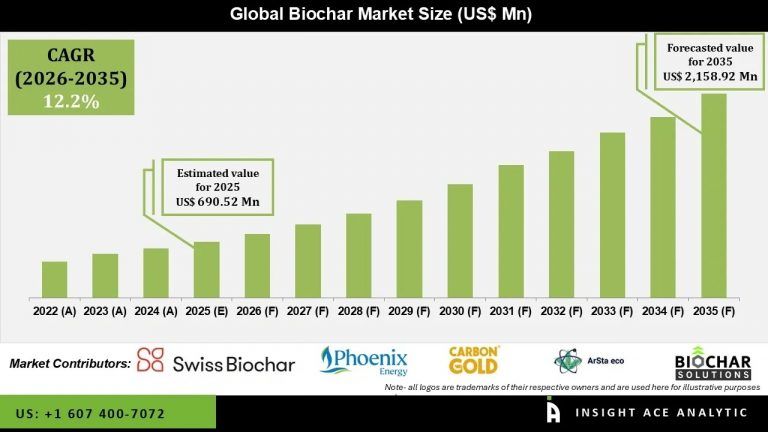
Global Biochar Market Set for Triple-Digit Growth by 2035
The Global Biochar Market is projected to nearly triple from an estimated US$ 690.52 Million in 2025 to US$ 2,158.92 Million by 2035, exhibiting a robust CAGR of 12.2%. This indicates strong demand and investment confidence in biochar applications.
Market Growth Unlocks Biochar CDR Scaling & Investment
This significant market expansion creates a highly favorable economic backdrop for biochar-based carbon removal (CDR) projects, even those with specific regional (e.g., India) or volumetric targets. A growing market provides essential liquidity, financing opportunities, and scalable infrastructure to support ambitious CDR initiatives.
Biochar Market Set for Explosive 13.83% CAGR Growth to 2034
The global biochar market is poised for significant expansion, projected to reach USD 2.73 billion by 2034 from USD 969.29 million in 2026, driven by a robust 13.83% CAGR. This sustained growth underscores increasing adoption for carbon removal and soil amendment applications.
(Source: Biochar Market Size, Share, Trends | Growth Analysis, 2034)
Investment Analysis: Offtake Agreements Unlocking Project Finance for Equilibrium
Recent offtake agreements are serving as the primary catalyst for unlocking significant equity and project-level investment into India’s biochar sector, shifting the financial model from reliance on early-stage venture capital to bankable, infrastructure-focused financing. The revenue certainty provided by long-term purchase commitments from buyers like Altitude and Microsoft directly enables developers such as Equilibrium and Varaha to secure the capital needed for facility construction and operational scaling. This move from speculative venture rounds to secured, project-backed finance marks a critical maturation point for the industry.
- The $25.2 million estimated value of the Equilibrium–Altitude offtake provides a clear financial foundation for project development. This guaranteed revenue stream de-risks the investment for capital providers, making it possible to build out the required production capacity.
- Venture funding is now explicitly tied to scaling capacity to meet these offtake demands. Equilibrium’s $3 million seed round in September 2025 was raised to scale its operations, a move validated less than a year later by the massive Altitude agreement.
- Similarly, Varaha’s $20 million investment in February 2026 was announced in conjunction with new partnerships, illustrating how capital inflows are now directly linked to proven commercial traction and the ability to fulfill large-scale carbon removal contracts.
Table: Biochar Sector Strategic Investments
| Partner / Project | Time Frame | Details and Strategic Purpose | Source |
|---|---|---|---|
| Varaha Investment | Feb. 2026 | Secured $20 million in a new funding round to scale its carbon removal operations, coinciding with the launch of new biochar partnerships. This capital is intended to expand its capacity to generate high-quality carbon credits for corporate buyers. | ESGDive |
| Equilibrium Seed Funding | Sep. 2025 | Raised $3 million in a seed funding round from investors including Peak XV Partners, Kalaari Capital, and Avaana Capital. The funds were earmarked for scaling the company’s full-stack climate infrastructure platform, including its biochar projects. | CDR.fyi |
Partnership Data: Equilibrium Deal Highlights Financier-Developer Model
Strategic partnerships between Indian project developers and international financiers or corporate offtakers have become the dominant model for scaling the country’s biochar industry, with the Equilibrium–Altitude deal epitomizing this trend. This symbiotic structure allows developers to focus on operational execution and infrastructure build-out, while financiers provide the bankable demand signal and upfront capital commitment needed for large-scale projects. This model contrasts sharply with the pre-2025 landscape, which was defined by smaller, more speculative project development without guaranteed buyers.
- The Equilibrium and Altitude partnership, announced in June 2026 for 180, 000 tonnes of carbon removal, is structured as a pure developer-financier relationship. Altitude provides the demand security, enabling Equilibrium to build and operate the necessary production facilities in Maharashtra.
- The Varaha and Microsoft agreement from January 2026 illustrates the corporate-developer model. Microsoft acts as the end-buyer, providing Varaha with a long-term contract that justifies investment in expanding its network of biochar production units.
- International collaboration extends beyond just offtake. In September 2025, Japan’s Green Carbon partnered with India’s Varhad Capital to launch one of the country’s largest biochar projects, demonstrating a model that combines international technology and domestic implementation expertise to accelerate growth.
Table: Key Indian Biochar Partnerships (2025-2026)
| Partnership | Time Frame | Details and Strategic Purpose | Source |
|---|---|---|---|
| Equilibrium & Altitude | Jun. 2026 | Multi-year offtake agreement for 180, 000 tonnes of biochar-based CDR. Altitude, a financier, provides the bankable contract, enabling Equilibrium to develop and scale its production infrastructure in India. | Carbon Herald |
| Varaha & Microsoft | Jan. 2026 | Varaha signed a biochar carbon removal offtake agreement with Microsoft. The partnership provides Varaha with a credible, large-scale buyer, validating its business model and facilitating expansion. | SMEStreet |
| Green Carbon & Varhad Capital | Sep. 2025 | Partnership to develop one of India’s largest biochar carbon removal projects. The collaboration aims to leverage Green Carbon‘s expertise and Varhad Capital‘s local market access to rapidly scale biochar production. | Green Carbon |
India’s Growing Dominance in Biochar: Equilibrium Deal Analysis
India is rapidly consolidating its position as a global hub for biochar-based carbon removal, driven by a convergence of abundant agricultural feedstock, a sophisticated ecosystem of project developers, and increasing validation from international buyers. The period from 2025 to 2026 marks a clear inflection point where the country transitioned from a region of potential to a core supplier in the global CDR market. This growth is exemplified by deals like the 180, 000-tonne Equilibrium contract, which leverages India’s unique advantages to deliver carbon removal at a scale few other regions can currently match.
- The availability of low-cost agricultural residues is a primary driver. Projects like Equilibrium‘s facility in Maharashtra are strategically located to convert agricultural waste, which would otherwise be burned, into a stable form of carbon while creating a revenue stream.
- A robust domestic developer ecosystem has emerged, with companies like Equilibrium, Varaha, and partners of Green Carbon building the operational capacity to execute complex, large-scale projects. This local expertise is critical for navigating logistical and supply chain challenges.
- Government and policy support, while still nascent, is beginning to provide a tailwind. The launch of India’s first state-level biochar policy by Himachal Pradesh in August 2025 signals growing official recognition of biochar’s dual benefits for climate mitigation and agricultural soil health.
- Before 2025, Indian biochar projects were largely unheralded and operated at a small scale. The recent string of high-profile, large-volume offtake agreements with buyers like Altitude and Microsoft has firmly placed India at the center of the global biochar supply map.

Biochar Dominates Current CDR Landscape
As of Q2/2025, Biochar accounts for a commanding 90% of all delivered Carbon Dioxide Removal (CDR), totaling 113 kilotonnes. This highlights biochar’s proven scalability and immediate impact compared to other methods like biomass geological storage (4.4%) or mineralization (3%).
Biochar’s Near-Term Scalability Essential for Meeting CDR Targets
The dominance of biochar in delivered CDR underscores its critical role in current climate action. While the question targets 180,000 tonnes by 2026, the current 113 kt delivered by Q2/2025 shows a significant existing capacity, making biochar a go-to solution for rapid scale-up. This indicates strong operational maturity and lower deployment barriers than nascent technologies.
Biochar CORC Issuance Surges, Nearing 400,000 Tonnes by 2025
Cumulative Biochar Carbon Removal Certificates (CORCs) issued by Puro.earth show explosive growth, rising from negligible levels in 2019 to approximately 400,000 CORCs by 2025. The sharpest acceleration occurred between 2022 and 2024, indicating rapid market adoption and scaling of biochar CDR projects globally.
(Source: Biochar Market Size, Share, Trends, & Industry Sales to 2035)
Technology Maturity: Biochar CDR Moves to Commercialization Stage
The core technology for producing biochar, pyrolysis, is well-established; however, the period from 2025 to the present has been defined by the commercial maturation of the *entire value chain* required for delivering high-integrity carbon removal credits at scale. This includes standardizing measurement and verification (MRV), optimizing logistics for biomass and biochar distribution, and creating the financial instruments for bankable projects. The Equilibrium–Altitude deal is a product of this maturation, not just of the production technology itself.
- Between 2021 and 2024, the focus was on demonstrating the scientific basis for biochar’s carbon sequestration potential and permanence. Projects were typically small, often grant-funded, and served as validation testbeds.
- The shift in 2025-2026 has been toward commercial and operational excellence. Companies like Equilibrium have built full-stack platforms that manage everything from feedstock sourcing to credit certification, turning a scientific process into a scalable industrial operation.
- The involvement of third-party certifiers like Isometric has been crucial. By providing a credible, independent registry and verification protocol, they have created a fungible, trusted asset (CORCs) that financiers like Altitude are willing to purchase in large volumes through multi-year contracts.
- The technology application is also broadening. While carbon removal is the primary driver for these deals, the co-benefits of biochar as a soil amendment are creating additional value streams, improving project economics, and encouraging adoption by farmers.
SWOT Analysis of India’s Biochar Sector
The Indian biochar sector’s rapid ascent is underpinned by clear strengths and opportunities, primarily related to feedstock availability and strong international demand, but it also faces operational threats and weaknesses that must be managed for sustained growth. The market’s evolution shows a clear trend of resolving earlier weaknesses, such as a lack of bankable projects, by leveraging strengths like a strong developer ecosystem to seize market opportunities.
- Strengths: India’s vast agricultural sector provides a massive, low-cost supply of biomass feedstock, a fundamental competitive advantage. This is complemented by a growing cohort of sophisticated domestic project developers like Equilibrium and Varaha.
- Weaknesses: The logistics of collecting, transporting, and processing agricultural waste at scale remain complex and can be a significant operational cost. The domestic market for biochar as a product is also still in its early stages.
- Opportunities: The primary opportunity is the immense and growing demand for high-integrity CDR from international corporations and financiers, as shown by the Altitude and Microsoft deals. Government policies promoting sustainable agriculture and waste management could provide further tailwinds.
- Threats: Potential threats include the emergence of lower-cost CDR alternatives, reputational risks from any projects that fail to meet rigorous MRV standards, and logistical bottlenecks that could constrain the pace of scaling.
Table: SWOT Analysis for India’s Biochar Sector
| SWOT Category | 2021 – 2024 | 2025 – 2026 | What Changed / Resolved / Validated |
|---|---|---|---|
| Strengths | Theoretical feedstock availability. Nascent developer presence. | Demonstrated ability to convert feedstock at scale. Emergence of experienced developers (Equilibrium, Varaha) with proven track records. | The theoretical advantage of feedstock access was validated by the successful execution and scaling of projects to meet initial demand. |
| Weaknesses | Fragmented projects with no clear path to scale. Lack of bankable offtake agreements. | Logistical complexity of scaling feedstock supply chains. Nascent domestic market for biochar soil amendment. | The lack of bankable projects was resolved by the entry of large-scale offtakers like Altitude, though operational logistics remain a key challenge. |
| Opportunities | Speculative interest from voluntary carbon market buyers. | Secured, large-volume, multi-year offtake deals from major financiers (Altitude) and corporations (Microsoft). Early government support signals (Himachal Pradesh plan). | The opportunity transitioned from speculative to concrete, with signed contracts worth tens of millions of dollars providing clear demand signals. |
| Threats | Questions around permanence and MRV of small-scale projects. | Risk of supply chain bottlenecks as industry scales. Competition from other global CDR hubs. Potential for price pressure as more supply comes online. | While initial MRV concerns were addressed by new standards (e.g., Isometric), the new threats are operational and market-based, related to the challenges of rapid growth. |
Scenario Modelling: Equilibrium’s Next Move and Market Price Signals
The most critical signal to watch in India’s biochar market over the next 12-18 months will be the pricing and terms of the next wave of large-scale offtake agreements. If developers like Equilibrium can secure follow-on contracts at or above the current estimated price of $140/tonne, it will validate the sustainability of the high-integrity market and accelerate further infrastructure investment. Conversely, significant price erosion would signal commoditization and could threaten the bankability of capital-intensive projects.
- If developers successfully execute on the initial delivery tranches for major offtakes like the Altitude deal, then watch for an acceleration of new project announcements and a fresh round of larger venture/growth equity funding for leading players like Equilibrium and Varaha.
- If the price per tonne in new large-volume agreements remains stable or increases, this could be happening because the demand for high-quality, fully verified CDR from a geopolitically stable region like India is outstripping the current pace of supply growth.
- If new entrants begin offering credits at a significant discount, this could be happening because of lower-quality MRV standards or a focus on volume over permanence, posing a risk to the reputation and pricing power of the entire Indian biochar market.
- The most likely scenario is that established developers with proven delivery track records, like Equilibrium, will command a premium price and attract the majority of follow-on financing, creating a tiered market where quality and reliability differentiate the leaders from the laggards.
The questions your competitors are already asking
This report covers one angle of India’s biochar market development. The questions that matter most depend on your work.
- Biochar carbon removal projects outside India
- Biochar carbon credit price trends
- Other feedstocks for biochar production
- Corporate buyers of biochar carbon credits
This report does not answer these. Enki Brief Pro does.
Your question, your angle, your framework. SWOT, PESTL, scenario modelling. The same niche depth, built around the decision your work actually depends on.
