

Plug Power PEM Fuel Cell Strategy, $132.5 M Asset Sale, 275 MW Hy 2 gen Deal, and Key Port Projects (2021 to 2026)
Fuel Cell Market Divergence: Plug Power’s Integrated Model vs Niche Competitors
The fuel cell market is fragmenting into two distinct strategic paths: Plug Power’s capital-intensive, vertically integrated ecosystem model versus the targeted, high-margin niche approach of competitors. While Plug Power aims to build and control the entire green hydrogen value chain for applications like warehouses and ports, rivals are concentrating on capturing the most profitable segments with more focused business models.
- Between 2021 and 2024, Plug Power cemented its market leadership by scaling its material handling equipment (MHE) business, deploying thousands of fuel cell forklifts for anchor customers like Amazon and Walmart. The strategy focused on demonstrating operational superiority over batteries in high-throughput logistics.
- Starting in 2025 and accelerating in 2026, Plug Power’s focus expanded to delivering large-scale industrial projects, including the 100 MW electrolyzer for Galp and a 275 MW system for Hy 2 gen, to validate its end-to-end green hydrogen production and supply model.
- In contrast, competitors have specialized. By 2026, Bloom Energy has established a strong position as a key provider of stationary solid-oxide fuel cells for the high-demand AI data center market, a lucrative niche Plug Power is now also targeting.
- Other rivals like Ballard Power Systems and Fuel Cell Energy are concentrating on specific applications such as heavy-duty mobility (trucks, buses) and utility-scale power generation, respectively, creating focused competition in sectors critical to port operations.
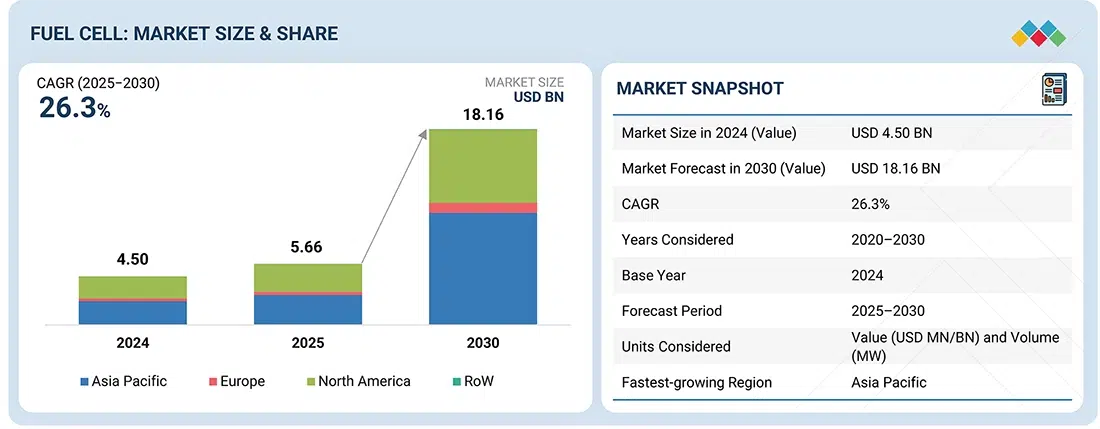
Global Fuel Cell Market to Exceed $18B by 2030
This chart provides a high-level forecast of the global fuel cell market’s growth, setting the stage for the section’s discussion of market fragmentation and Plug Power’s leadership role.
(Source: MarketsandMarkets)
$132.5 M Asset Sale, Plug Power’s Capital Reallocation and Financial Pressure
In 2026, Plug Power initiated a significant strategic shift from pure capital expansion to active financial management, using asset sales to bolster its balance sheet and fund operations amid substantial ongoing losses. This pivot reflects the intense financial pressure of its vertically integrated strategy and the need to achieve profitability.
- The most direct signal of this shift was the February 2026 definitive agreement to sell a planned green hydrogen plant site in New York to Stream Data Centers for $132.5 million, a move designed to generate immediate liquidity.
- This capital reallocation was driven by severe financial underperformance, with the company reporting a trailing twelve-month operating loss of $1.5 billion and a negative gross margin of -34.1% in early 2026.
- In January 2026, the company also announced its intent to ask shareholders to approve a doubling of authorized shares from 1.5 billion to 3 billion, an action aimed at securing future funding to cover its high cash burn rate.
- This contrasts with the 2021-2024 period, which was characterized by aggressive investment into building out new production facilities, whereas 2026 is defined by the strategic monetization of certain assets to stabilize its core business.
Plug Power Capital and Asset Management (2026)
| Partner / Project | Time Frame | Details and Strategic Purpose | Source |
|---|---|---|---|
| Stream Data Centers | Feb 26, 2026 | Executed a $132.5 million asset sale of a New York site originally intended for a hydrogen plant. The goal was to unlock value from non-core assets to improve liquidity. | Plug Power IR |
| Proposed Share Dilution | Jan 28, 2026 | Announced intent to ask shareholders to approve a doubling of company shares to 3 billion. This is a measure to raise capital to fund future operations amid significant cash burn. | Hydrogen Insight |
Plug Power 6 Key Commercial Agreements from Ports to F 1 (2026)
Plug Power’s 2026 commercial agreements and projects signal a deliberate push beyond its established warehouse logistics base into industrial-scale hydrogen production and supply, targeting high-value markets like ports and industrial decarbonization.
- In April 2026, Plug Power secured a major contract to supply a 275 MW Gen Eco electrolyzer system for Hy 2 gen’s decarbonized ammonium nitrate project in Quebec, one of its largest electrolyzer deals to date.
- The company established a critical foothold in European port infrastructure in February 2026 by completing the first hydrogen fill for Hynetwork’s pipeline at the Port of Rotterdam, delivering 32 tons of certified green hydrogen.
- Its industrial-scale capabilities were further validated in January 2026 with the completed installation of 100 MW of PEM electrolyzers at Galp’s Sines Refinery in Portugal, a project designed to produce 15, 000 tons of renewable hydrogen annually.
- Beyond industrial supply, Plug Power formed a high-visibility partnership with the Alpine F 1 Team in March 2026 to promote hydrogen in motorsports and announced a deal with NASA in January 2026 for hydrogen solutions.
- These new ventures build on foundational relationships with Amazon and Walmart, whose distribution centers host the majority of Plug Power’s more than 72, 000 deployed fuel cell systems.
Plug Power Strategic Partnerships (2026)
| Partner / Project | Time Frame | Details and Strategic Purpose | Source |
|---|---|---|---|
| Hy 2 gen | Apr 2, 2026 | Selected to supply a 275 MW Gen Eco electrolyzer system for a decarbonized ammonium nitrate project in Quebec, Canada, validating its technology for large-scale industrial chemical production. | Fuel Cells Works |
| Iberdrola & BP | Mar 27, 2026 | A 25 MW electrolyzer project in Spain developed with the two energy majors was reported as nearing commissioning, demonstrating collaboration with established European energy players. | Yahoo Finance |
| Hynetwork (Port of Rotterdam) | Feb 4, 2026 | Completed the first hydrogen supply to a key pipeline segment with 32 tons of green hydrogen, establishing a commercial hydrogen hub in Europe’s largest port. | Plug Power IR |
| Galp (Sines Refinery) | Jan 23, 2026 | Completed installation of a 100 MW Gen Eco electrolyzer system at a major European refinery, aimed at reducing industrial emissions by producing green hydrogen for refinery processes. | Globe Newswire |
North America vs Europe: Plug Power’s Dual-Front Expansion
While North America remains the bedrock of Plug Power’s commercial success in material handling, its strategic focus in 2026 has pivoted aggressively toward Europe to secure and deliver large-scale industrial green hydrogen projects. This dual-front strategy leverages its established US customer base while pursuing higher-value industrial decarbonization opportunities abroad, diversifying its geographic risk and market exposure.

North American Fuel Cell Market to Double by 2033
This chart quantifies the growth opportunity in the North American market, which the section identifies as the bedrock of Plug Power’s commercial success before its pivot to Europe.
(Source: Market Data Forecast)
- The period from 2021 to 2024 was predominantly US-centric, built on the scaled deployment of over 72, 000 fuel cell systems across the distribution networks of domestic giants like Amazon, Walmart, and Home Depot.
- In 2025 and 2026, Europe became the primary theater for industrial-scale validation projects. Key activities include the 100 MW electrolyzer installation for Galp in Portugal, the 32-ton green hydrogen delivery at the Port of Rotterdam in the Netherlands, and the 25 MW project with Iberdrola and BP in Spain.
- North America remains a critical growth engine, demonstrated by the landmark 275 MW electrolyzer agreement with Hy 2 gen in Quebec, Canada, and the company’s stated ambition to enter the US AI data center power market.
- The company is also making early-stage entries into new regions, highlighted by the operational launch of a 5 MW electrolyzer system with Cleanergy Solutions in Namibia in January 2026, signaling its global ambitions.
PEM Fuel Cell Commercial Scale: Plug Power Moves from Forklifts to Refineries
Plug Power’s PEM fuel cell technology is fully commercialized and proven at scale in material handling, and 2026 marks a critical test of its economic scalability in industrial-grade electrolyzer applications for markets like ports and refineries. The core challenge has shifted from technological viability, which is established, to achieving profitable unit economics at a much larger system size.

PEM Fuel Cells Poised to Dominate Future Revenue
This chart specifically highlights the growing commercial importance of PEM fuel cells, directly aligning with the section’s focus on scaling this exact technology for new industrial applications.
(Source: MarketsandMarkets)
- In the 2021-2024 timeframe, the deployment of over 72, 000 Gen Drive fuel cell units in forklifts served as definitive validation of the technology’s reliability, durability, and operational advantages over incumbent battery solutions in demanding, 24/7 logistics environments.
- The period from 2025 to 2026 is defined by the scalability test of its Gen Eco PEM electrolyzers. The successful installation of the 100 MW system for Galp and the large supply agreement for the 275 MW Hy 2 gen project are the primary proof points for its industrial-grade capabilities.
- The persistent negative gross margins, however, indicate that the economic model for producing and delivering green hydrogen at scale remains the company’s primary obstacle. Its vertical integration strategy is designed to address this by controlling costs across the value chain, but it has not yet proven profitable.
- The technology’s application is now expanding to new use cases like stationary power for AI data centers, demonstrating its versatility but also putting it in direct competition with other mature technologies from firms like Doosan and Ceres Power.
Plug Power SWOT Analysis: Strengths in Scale, Weakness in Financials (2026)
Plug Power’s market position is defined by a powerful combination of first-mover scale and an integrated ecosystem, but this strength is critically undermined by persistent financial losses and the immense execution risk of its capital-intensive strategy. The company’s future depends on its ability to leverage its market-leading strengths to overcome its profound financial weaknesses before focused competitors capture the most valuable emerging market segments.

Market Growth Tempered by High Infrastructure Costs
This chart outlines both drivers and restraints, such as high costs, which directly reflects the SWOT analysis’s theme of balancing market strengths against significant financial weaknesses and risks.
(Source: SkyQuest Technology Consulting)
SWOT Analysis for Plug Power’s Fuel Cell Strategy (2026)
| SWOT Category | 2021 – 2024 | 2025 – 2026 | What Changed / Resolved / Validated |
|---|---|---|---|
| Strength | Market dominance in MHE with deep customer integration (Amazon, Walmart). Proven reliability of fuel cell technology at scale (50, 000+ units deployed). | First-mover advantage as a vertically integrated hydrogen provider (electrolyzers, liquid H 2, fueling stations). Deployed over 72, 000 fuel cell systems and 275 stations. | The strategic shift from being a component supplier to a full ecosystem provider was validated, creating a significant competitive moat. |
| Weakness | Consistent unprofitability and high cash burn. Heavy reliance on a small number of large customers for a majority of revenue. | Worsening financial performance, with a negative gross margin of -34.1% and an operating loss of $1.5 B. High capital intensity forces asset sales ($132.5 M sale) and potential share dilution. | Financial pressure has intensified, shifting the company’s focus from pure growth to capital preservation and operational efficiency. |
| Opportunity | Expansion into adjacent markets beyond MHE, such as stationary power and on-road vehicles. Growing political support for hydrogen. | Massive new addressable markets in port decarbonization, industrial green hydrogen production (refineries, ammonia), and AI data center power. Overall fuel cell market projected to grow by $59.5 B from 2026-2030. | The market opportunity has expanded far beyond logistics into heavy industry, validating the company’s pivot to larger-scale electrolyzer projects. |
| Threat | Improvements in industrial battery technology. Fluctuations in government subsidies and incentives for hydrogen. | Highly focused and financially disciplined competitors like Bloom Energy capturing high-margin niches (data centers). Execution risk on large, complex industrial projects. | The competitive threat has evolved from technology-based (batteries) to strategy-based (focused vs. broad-front), with rivals targeting profitability over market share. |
Q 4 2026 Profitability Target: Plug Power’s Critical Execution Test
Plug Power’s entire strategic position hinges on its ability to meet its stated goal of achieving positive EBITDA by the fourth quarter of 2026, a critical milestone that will either validate or undermine its capital-intensive, vertically integrated business model.

Global Hydrogen Fuel Cell Market Reaches $7.4B in 2026
The chart projects the market size specifically for 2026, providing crucial financial context for the section’s focus on Plug Power’s critical profitability target in that same year.
(Source: Market.us)
- If Plug Power successfully commissions its large-scale electrolyzer projects like those for Galp and Hy 2 gen on time and converts them into profitable, recurring revenue streams, watch for a significant improvement in investor confidence and an acceleration of new industrial-scale contract announcements.
- The performance of new CEO Jose Luis Crespo, appointed in March 2026, is the central variable. His ability to instill operational discipline and translate revenue growth into positive cash flow will determine the company’s trajectory.
- Conversely, if project delays mount, or if focused competitors like Bloom Energy or Hyundai secure major port or industrial power contracts first, Plug Power will face intensified pressure to further divest assets or raise more dilutive capital.
- Failure to meet its Q 4 2026 profitability target would signal that its all-in-one ecosystem strategy is economically unsustainable, risking its leadership position and its ability to fund future growth in the competitive fuel cell market.
The questions your competitors are already asking
This report covers one angle of the fuel cell market for warehouses and ports. The questions that matter most depend on your work.
- Which companies are gaining or losing ground in the fuel cell market for material handling and port equipment?
- What is the outlook for PEM fuel cell deployment in warehouses and ports by 2026?
- How do PEM fuel cells compare to batteries for material handling equipment in high-throughput warehouses?
- Which port operators and logistics companies are adopting hydrogen fuel cells for their equipment?
This report does not answer these. Enki Brief Pro does.
Your question, your angle, your framework. SWOT, PESTL, scenario modelling. The same niche depth, built around the decision your work actually depends on.
