

CCUS Profitable Decarbonization: U.S. Steel’s $150 M Carbon Free Project, 50, 000-Ton Chemical Output (2021 to 2026)
Industry Adoption: U.S. Steel’s Shift to Profitable CCUS Projects
The primary shift in steel decarbonization from 2021 to 2026 is the transition from carbon capture and storage (CCS) as a cost-based compliance tool to carbon capture and utilization (CCU) as a revenue-generating, circular economy model, validated by U.S. Steel’s pilot project. This move signals a market evolution where industrial emissions are re-framed as valuable feedstocks rather than liabilities requiring costly disposal.
- Between 2021 and 2024, the industry focus was largely on announcing large-scale CCS projects, such as the Nucor and Exxon Mobil agreement for geological storage, which treated CO 2 as a waste product to be buried. The U.S. Steel and Carbon Free Mo U was announced in 2023, but the full economic and strategic implications were still emerging.
- From 2025 forward, the model is increasingly defined by value creation. The U.S. Steel project moves toward a 2026 operational date, aiming to convert 50, 000 metric tons of CO 2 and steel slag into high-value precipitated calcium carbonate (PCC) and baking soda annually.
- This strategic pivot demonstrates that the market is beginning to favor integrated solutions that create new products, reduce landfill waste through slag valorization, and build resilient, localized chemical supply chains, moving beyond the limitations of simple sequestration. Other large industrial players like Holcim are also exploring large-scale carbon capture, highlighting a broader industry trend.
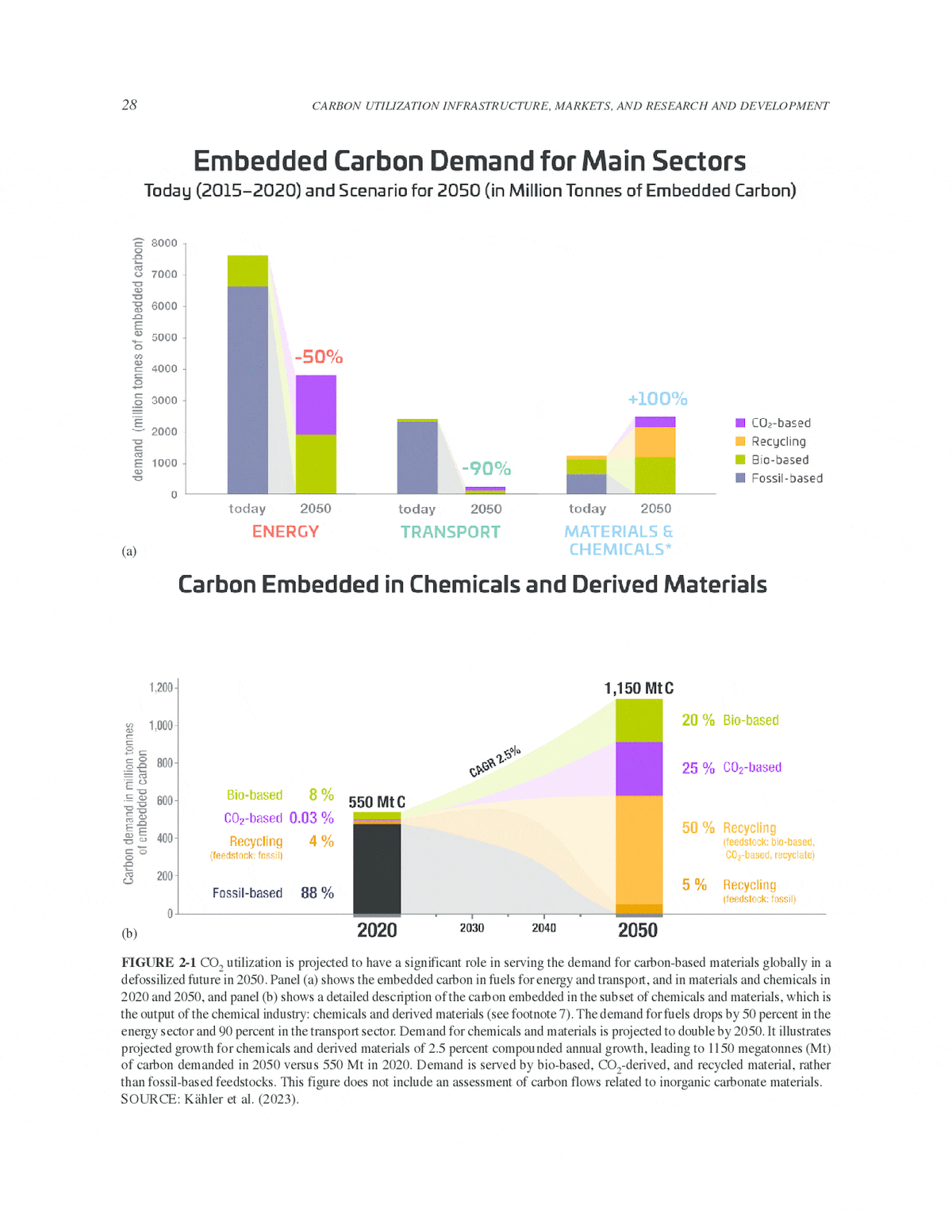
CO2-to-Chemicals Market Set for Growth
This chart shows the significant market potential for CO2-based chemical feedstocks, supporting the article’s thesis that the industry is shifting from a cost-based to a revenue-generating model.
Investment Analysis: U.S. Steel’s $150 M Carbon-to-Chemicals Model (2021 to 2026)
The $150 million capital investment into the U.S. Steel Gary Works project demonstrates a strategic pivot towards smaller, highly profitable CCU projects with rapid payback periods, contrasting with larger, more uncertain long-term CCS infrastructure developments. The financial viability of this approach fundamentally alters the economic calculus of industrial decarbonization.
- The project’s economics are built on a diversified value stack. The model combines product sales revenue (estimated at ~$28.4 million annually), federal 45 Q tax credits ($3 million annually), and avoided slag disposal costs (~$3.4 million annually).
- This structure creates a total estimated annual value of ~$34.8 million, yielding a simple payback period of approximately 4.3 years on the $150 million CAPEX. This return profile is highly attractive for industrial capital projects and provides a bankable template for future investments.
- This financial model turns the cost of abatement negative. Unlike traditional CCS, which costs $50-$100 per ton to sequester CO 2, this CCU model is projected to generate a profit for each ton of CO 2 utilized, making emissions reduction an economically sustainable activity.
Table: U.S. Steel CCU vs. Traditional CCS Economic Comparison
| Metric | Time Frame | U.S. Steel / Carbon Free CCU Model | Traditional Geological CCS Model | Source |
|---|---|---|---|---|
| Primary Revenue Source | 2025-2026 | Sale of precipitated calcium carbonate (PCC) and other chemicals, generating ~$28.4 M annually. | None. Relies solely on tax credits or incentives. | Canary Media |
| 45 Q Tax Credit Value | Post-IRA | $60 per ton for utilization via mineralization. | $85 per ton for permanent geological sequestration. | RMI |
| Avoided Costs | 2025-2026 | Avoids slag disposal costs, estimated at $15-$40 per ton, adding ~$3.4 M in value. | None. Incurs additional long-term monitoring costs for storage sites. | Okon Recycling |
| Net Cost of Abatement | 2026 Est. | Potentially negative (profitable), as revenue and savings are projected to exceed OPEX. | Positive cost center, typically estimated between $50-$100 per ton. | IEA |
Geography: U.S. Steel Leads North America’s Profitable CCU Model
While global CCUS activity has historically included large-scale projects focused on enhanced oil recovery (EOR), the North American market, led by the U.S., is now pioneering a different model focused on converting CO 2 into value-added products, supported by strong federal incentives. This regional specialization is creating a distinct and potentially more scalable pathway for industrial decarbonization.
- Between 2021 and 2024, the global context was partially defined by large-scale projects like the 800, 000 ton-per-year Al Reyadah facility in Abu Dhabi, which has been operational since 2016 and uses CO 2 for EOR.
- From 2025 onward, the U.S. has solidified its position as a hub for CCUS innovation, driven by the Inflation Reduction Act. The U.S. Steel project in Gary, Indiana, and the Nucor project in Louisiana signify a concentration of activity in America’s industrial heartland, with a clear focus on both utilization and sequestration.
- The key U.S. differentiator is its policy framework, which provides specific credits for both utilization ($60/ton) and sequestration ($85/ton). This policy flexibility makes diverse business models viable and is attracting a forecast $77.5 billion in capital investment for domestic carbon capture projects. The growth of the EU Carbon Market shows how policy is a major driver globally.
Technology Maturity: U.S. Steel Validates Commercial-Scale Mineralization
Carbon Free’s Sky Cycle™ technology is moving from demonstration to a commercial-scale pilot at U.S. Steel, representing a critical step in validating mineralization as a scalable and profitable decarbonization pathway for heavy industry. This project serves as a key validation point for turning CO 2 into solid, stable, and valuable materials.

Analysis Ranks Top CO2 Utilization Pathways
This analysis ranks CO2 utilization pathways by criteria including technology readiness level (TRL), validating the article’s point that mineralization is now seen as a mature, top-ranked pathway.
(Source: ScienceDirect.com)
- Between 2021 and 2024, mineralization was often discussed as a promising but less mature pathway compared to established technologies like amine scrubbing for CCS. The announcement of the $150 M project in 2023 was a key signal of its perceived commercial readiness.
- In 2025-2026, the project moves into a full industrial operating environment. Its primary objective is to validate the technology’s performance and economic model for future, larger deployments across other steel and cement facilities, effectively de-risking the technology for the broader market.
- A key technical benchmark will be the efficiency of its slag valorization process compared to competitors like Cemvision, which claims a 99% iron recovery rate from slag. The ability to maximize value from all industrial byproducts is crucial for long-term competitive advantage.
- While the project competes with other decarbonization technologies, its strength is as a “bridge” solution that complements other approaches. It can be retrofitted onto existing assets for immediate profit, generating cash flow that can help fund longer-term transitions to technologies like green hydrogen or advanced technologies from companies like Fuel Cell Energy.
SWOT Analysis: U.S. Steel’s Profitable Decarbonization Model
The U.S. Steel project’s primary strength lies in its innovative, multi-stream revenue model that transforms waste into value, but it faces potential threats from commodity price volatility and a dependency on stable government policy. Its success hinges on balancing these factors to prove the model’s long-term sustainability.

Evaluating Strategic Options for CO2 Use
This multi-criteria analysis mirrors a SWOT by scoring CO2 utilization pathways against factors like revenue potential and cost, framing the strategic trade-offs U.S. Steel faces.
(Source: ScienceDirect.com)
Table: SWOT Analysis for U.S. Steel’s Carbon-to-Chemicals Model
| SWOT Category | 2021 – 2024 | 2025 – Today | What Changed / Validated |
|---|---|---|---|
| Strengths | The project was announced with a clear circular economy concept: use waste CO 2 and slag to make a product. | The financial model is quantified, showing an estimated ~$34.8 M annual value and a <5-year payback on a $150 M CAPEX. | The economic viability has been validated with specific revenue figures, moving the project from a concept to a bankable business case. |
| Weaknesses | The project’s scale (50, 000 tons/year) was seen as a small demonstration relative to a steel mill’s total emissions. | The scale remains a pilot, and the CAPEX per ton ($3, 000) is confirmed to be high, though justified by the revenue stream. | The weakness is validated but accepted as part of a first-of-a-kind commercial pilot. The focus is on proving profitability before scaling. |
| Opportunities | The Inflation Reduction Act was passed, creating a strong tailwind with the enhanced 45 Q tax credit. | Market forecasts project the global CCUS market to exceed $12 billion by 2030, confirming strong demand for such technologies. | The market opportunity has grown significantly, providing a strong backdrop for scaling and replicating the model at other industrial sites. |
| Threats | Potential for regulatory uncertainty and reliance on nascent markets for carbon-based products. | Threats are now more specific: volatility in PCC market prices and the risk of future changes to the 45 Q tax credit framework. | The general risks have sharpened into specific market and policy dependencies that must be managed for long-term profitability. |
Scenario Modeling: U.S. Steel’s 2026 Outlook and Model Replication
If the Gary Works pilot meets its operational and financial targets by its 2026 commissioning date, the key signal to watch will be U.S. Steel’s announcement of a second, larger-scale project at another facility, confirming the model’s replicability and scalability. Success is not just about capturing carbon; it is about proving a new business model for industrial America.

Industrial Decarbonization Roadmap Visualized
This waterfall chart visualizes a long-term decarbonization strategy, representing the type of scalable, replicable roadmap that the U.S. Steel project aims to prove is possible.
(Source: Crack The Market – Substack)
- Success will be measured not just by CO 2 capture rates but by the consistent production of on-spec chemicals and achieving the projected ~$35 million annual value stream. Any deviation will signal potential challenges in scaling the technology.
- Watch for the announcement of long-term offtake agreements for the carbon-negative PCC. Securing these contracts with buyers in the paper, plastics, or paint industries would de-risk the model from commodity price fluctuations and validate the “green premium” for these products.
- Monitor announcements from competitors in the steel and cement sectors. If companies like Heidelberg Materials or other major industrial players announce similar carbon-to-value projects, it will confirm a broader industry shift toward this profitable decarbonization strategy, moving beyond approaches favored by companies like Occidental.
The questions your competitors are already asking
This report covers one angle of U.S. Steel’s profitable CCU decarbonization model. The questions that matter most depend on your work.
- U.S. Steel investments and funding. Is the $150M carbon-to-chemicals project on track for its 2026 operational target?
- Which companies are gaining ground by framing industrial decarbonization as a profitable CCU business model instead of a CCS cost center?
- Which other steel and cement operators are adopting CCU solutions that create valuable products from captured CO2 and industrial slag?
This report does not answer these. Enki Brief Pro does.
Your question, your angle, your framework. SWOT, PESTL, scenario modelling. The same niche depth, built around the decision your work actually depends on.
