

Tasmea Data Center M&A, A$254 M Maxim Deal, 31% EPS Accretion and A$1.3 B Pipeline (2025 to 2026)
Data Center Construction Risks, Tasmea A$254 M Acquisition of Maxim Group
Industrial services firms are acquiring specialized electrical contractors to bypass substantial barriers to entry, namely technical expertise and client relationships, in the high-growth AI data center construction market. This strategic shift addresses the primary constraint on data center growth: the availability of power and the specialized engineering know-how to manage it. The acquisition of Maxim Group by Tasmea Limited is a direct response to this market reality, serving as a model for entering a technically demanding sector through capability acquisition rather than organic development.
- Between 2021 and 2024, data center growth was robust but followed predictable expansion patterns. The market inflection occurred in 2025 and 2026 as the immense power requirements of AI infrastructure, with racks demanding 50–100 k W compared to the previous 5–10 k W, elevated specialized electrical infrastructure from a component to the central bottleneck of new construction. This made proven specialists like Maxim Group highly valuable acquisition targets.
- Tasmea‘s A$254 million acquisition provides an immediate, non-replicable foothold in this market by absorbing Maxim‘s approximately 600 skilled employees, its entrenched relationships with major data center operators, and a secured project pipeline exceeding A$1.3 billion. This bypasses the years required to build comparable technical credibility and client trust organically.
- This “picks and shovels” strategy mirrors moves by industrial giants in other emerging high-tech sectors. For example, Honeywell‘s 2025 acquisition of Johnson Matthey‘s Catalyst Technologies business was a similar play to secure critical intellectual property and process technology for the sustainable aviation fuel market, validating the approach of buying expertise to ensure market leadership.
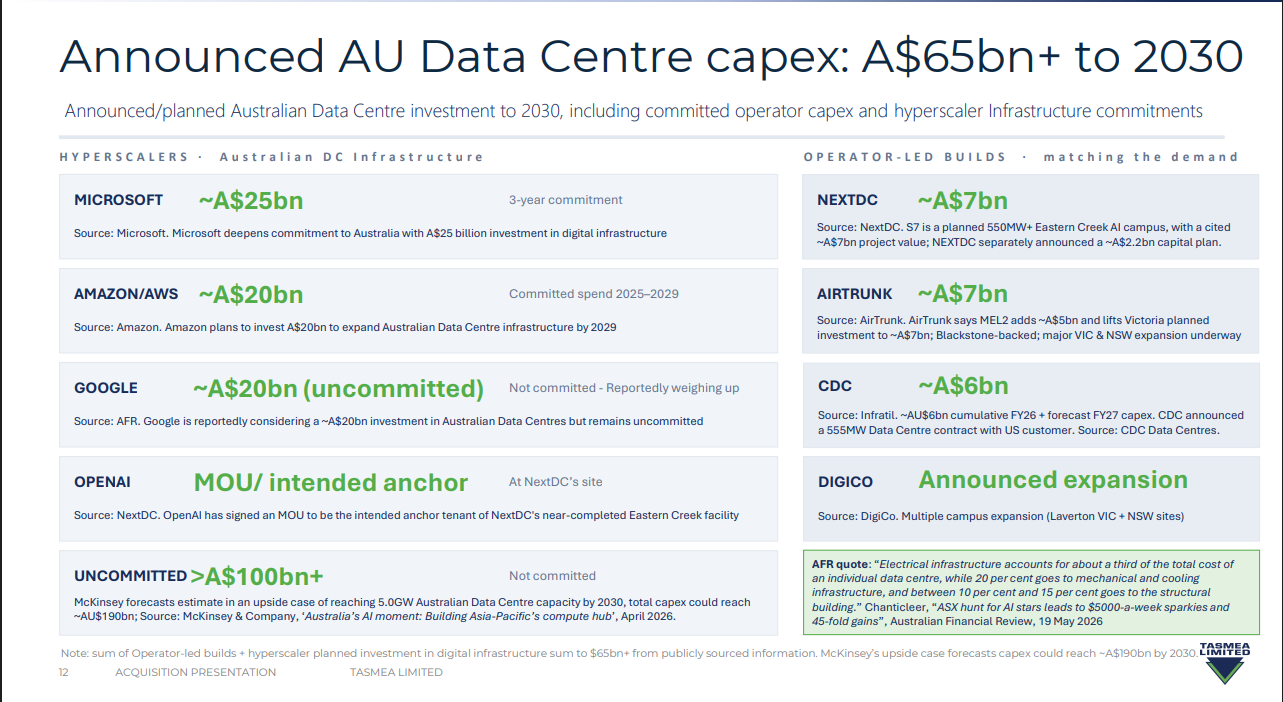
Australian Data Centre Capex to Exceed A$65B
This chart highlights the massive capital expenditure in the Australian data center market, which contextualizes the scale and inherent financial risks associated with the construction projects Tasmea is entering via the Maxim acquisition.
(Source: Mr Bomb – Substack)
A$254 M Transaction, Tasmea’s Acquisition of Maxim Group
The Tasmea-Maxim deal structure, which combines upfront cash and shares with a significant performance-based earnout, is engineered to de-risk the acquisition for Tasmea while retaining and incentivizing Maxim‘s key talent to drive post-merger growth. The transaction’s valuation and projected financial returns underscore the strategic premium placed on specialized expertise in the current market. This contrasts with the broader M&A environment, which saw larger, more financially-driven consolidation by private equity.
- The total consideration of up to A$254 million includes A$184 million upfront (A$112 million in cash and A$72 million in Tasmea shares) and a performance-based earnout of up to A$70 million. This structure ensures Maxim‘s previous owners are aligned with Tasmea‘s long-term objectives and are motivated to deliver on the project pipeline.
- The acquisition was priced at an attractive multiple of 5.4 x EBIT, a valuation that reflects the strategic fit more than pure financial engineering. The deal is expected to deliver an immediate and significant 31% earnings per share (EPS) accretion for Tasmea, validating the financial logic behind the strategic pivot.
- While data center M&A activity reached nearly $70 billion in 2025, much of it was driven by large-scale asset consolidation from private equity. Tasmea‘s targeted, capability-driven acquisition stands out as a strategic industrial play to secure a specific, high-value role in the hyperscaler supply chain.

Maxim Group Profiled Amidst Tasmea Acquisition
The chart introduces Maxim Group, the target of the acquisition, providing essential context for the A$254 M transaction detailed in this section.
(Source: Mr Bomb – Substack)
Table: Tasmea’s Acquisition of Maxim Group Transaction Details
| Metric | Value (A$) | Value (US$) | Source |
|---|---|---|---|
| Total Consideration | Up to $254 million | ~$168 million | [PDF] TASMEA TO ACQUIRE MAXIM GROUP |
| Upfront Consideration | $184 million | ~$122 million | [PDF] TASMEA TO ACQUIRE MAXIM GROUP |
| – Upfront Cash | $112 million | ~$74 million | Yahoo Finance |
| – Upfront Shares | $72 million | ~$48 million | Yahoo Finance |
| Earnout Consideration | Up to $70 million | ~$46 million | [PDF] TASMEA TO ACQUIRE MAXIM GROUP |
| Valuation Multiple (EBIT) | 5.4 x | 5.4 x | Stocks Down Under |
| Expected EPS Accretion | 31% | 31% | Stocks Down Under |

Tasmea Details Acquisition of Maxim Group
This chart provides a granular breakdown of the Maxim Group acquisition, aligning perfectly with the table’s purpose of detailing the transaction’s specifics.
(Source: Mr Bomb – Substack)
Australian Market Focus, Tasmea Leverages Maxim’s Victorian Presence
The acquisition strategically positions Tasmea to dominate the Victorian data center market, projected for a 22% CAGR between 2025 and 2030, while creating a platform for national expansion by marrying Maxim‘s niche expertise with Tasmea‘s broader geographical footprint. This move represents a deliberate shift from broad industrial services to a concentrated, high-value geographical and sectoral strategy, capitalizing on an acute regional need for digital infrastructure.
- Prior to 2025, Tasmea‘s operations were diversified across various industrial sectors throughout Australia. The acquisition of Maxim marks a decisive pivot, concentrating significant resources to capture a leading share of the data center construction boom centered in Victoria, where Maxim has a well-established 7+ year project pipeline and a strong track record.
- The core synergy of the deal is geographic expansion. Tasmea‘s existing national network provides the corporate infrastructure and client relationships to deploy Maxim‘s specialized data center construction teams to other emerging Australian hubs. This strategy aims to transform Maxim from a regional leader into a national powerhouse for digital infrastructure projects.
- This regional concentration is critical as power and grid constraints become more pronounced across Australia. By securing a leading contractor in a key growth corridor, Tasmea gains a strategic advantage in a market where the ability to execute complex electrical projects is a primary determinant of success, a challenge also seen in major US markets like the PJM interconnection.
Technology Acquisition, Tasmea Gains High-Density Power Expertise
The “technology” acquired by Tasmea is not a patent or a product, but mature, specialized human expertise in designing and installing complex electrical systems for AI-ready data centers, a capability that is commercially proven and in high demand. This is an acquisition of critical engineering knowledge that has become a primary factor of production in the digital economy.
- From 2021 to 2024, data center electrical systems were complex but largely an evolution of existing designs. The market shifted definitively in 2025 as the commercialization of generative AI drove a tenfold increase in rack power density, rendering traditional expertise insufficient and creating a sudden, massive demand for specialists.
- Maxim‘s value lies in its proven proficiency with the specific systems required for these new facilities, including high-capacity switchgear, busway power distribution, and multi-layered redundant power systems. This expertise is essential for managing projects where construction costs can exceed $20 million per megawatt, largely driven by electrical infrastructure needs for technologies like liquid cooling.
- Unlike R&D ventures, this acquisition involves a fully mature, commercially validated, and scarce skill set. Tasmea is not investing in future potential but buying present-day, revenue-generating capability that is a prerequisite for competing in the high-stakes data center construction market for clients like Microsoft.

Tasmea Stock Rises After Maxim Group Deal
The market’s positive reaction, reflected in the rising stock price, validates the strategic value of acquiring Maxim’s specialized technology and high-density power expertise.
(Source: Simply Wall St)
SWOT Analysis, Tasmea’s Data Center Market Entry via Maxim
Tasmea‘s acquisition of Maxim provides immediate market entry into a high-growth sector and promises significant financial accretion but introduces execution risks centered on talent retention and market risks tied to systemic power grid constraints. The success of the merger hinges on integrating a specialized, high-performance culture without diluting its core value, while navigating external factors beyond its direct control.

Tasmea Ltd. Ranks in ASX Top 10 Momentum
The chart quantifies Tasmea’s strong market position, which serves as a significant ‘Strength’ in the context of a SWOT analysis for its ambitious data center market entry strategy.
(Source: Finer Market Points)
Table: SWOT Analysis for Tasmea’s Data Center M&A Strategy
| SWOT Category | Pre-Acquisition (2021 – 2024) | Post-Acquisition (2025 – 2026) | What Changed / Validated |
|---|---|---|---|
| Strengths | Diversified industrial services firm with national scale and broad project management capabilities. | Immediate entry into high-growth data center market with specialized expertise, a $1.3 B+ project pipeline, and strong client relationships. Revenue stream diversification away from cyclical industrial markets. | The acquisition validates the strategy of buying, rather than building, scarce technical expertise. It provides a credible platform to capture a share of the AI infrastructure boom, projecting 31% EPS accretion. |
| Weaknesses | No specialized expertise or track record in the high-density data center construction sector. Exposed to cyclicality of traditional industrial markets. | Integration risk of merging a specialized, nimble company into a larger corporate structure. High dependence on retaining Maxim‘s key management and technical staff. | The primary weakness shifts from a market-access problem to an internal execution challenge. The deal’s success is now contingent on cultural integration and talent retention, managed partially by the earnout structure. |
| Opportunities | Potential to enter adjacent high-growth markets. Ability to leverage national scale for new ventures. | Cross-sell broader industrial services (HVAC, mechanical) to Maxim‘s data center clients. Leverage Tasmea‘s national footprint to expand Maxim‘s services beyond Victoria. | The deal creates concrete revenue synergies. Tasmea can now offer integrated project packages and pursue data center projects nationwide, transforming a regional opportunity into a national growth engine. |
| Threats | General economic downturn impacting industrial capital expenditure. Competitive pressures in traditional service markets. | The business is now directly exposed to data center sector risks: capital expenditure slowdowns from Big Tech, and systemic bottlenecks in power grid capacity and critical electrical component supply chains (e.g., transformers). | The risk profile shifts from broad economic cyclicality to specific, acute infrastructure constraints. The success of the acquired business is now tied to the ability of utilities like Dominion Energy to deliver power at scale. |

Tasmea’s Valuation Arbitrage Strategy in Data Centers
This chart visualizes a core component of Tasmea’s M&A approach, fitting perfectly into a SWOT analysis table as a key ‘Strength’ or ‘Opportunity’ in its strategy.
(Source: Mr Bomb – Substack)
Tasmea 2026-2027 Outlook: National Expansion vs. Integration Risk
The critical factor for Tasmea in the next 18 months is whether it can successfully replicate Maxim‘s model in other Australian states while retaining its key personnel, or if integration challenges will confine its success to the Victorian market. The primary signal to watch will be the geographic distribution of new project wins, which will validate or challenge the national expansion thesis underpinning the acquisition.
- If Tasmea successfully leverages its national scale to deploy Maxim‘s teams on projects outside Victoria, watch for announcements of new data center electrical contracts in key markets like Sydney. This would confirm the successful transfer and scaling of the acquired capability.
- This would also validate the revenue synergy thesis, proving that Tasmea can effectively cross-sell its broader services and use its corporate muscle to win larger, integrated projects across the country, potentially including on-site generation with partners like Fuel Cell Energy.
- Conversely, if senior management and key technical experts from Maxim depart post-acquisition, or if new project wins remain concentrated solely in Victoria despite a national demand surge, it could signal integration friction. This would cap the deal’s strategic value, turning a national platform play into a successful but limited regional investment.

Maxim Acquisition Forecast to Boost Tasmea Financials
The chart’s financial forecast for Tasmea post-acquisition directly supports the ‘2026-2027 Outlook’ by quantifying the expected positive impact, which contrasts with the mentioned integration risk.
(Source: Mr Bomb – Substack)
The questions your competitors are already asking
This report covers one angle of industrial services M&A into the data center construction market. The questions that matter most depend on your work.
- Which other industrial services firms are acquiring specialized contractors to enter the AI data center market?
- Tasmea’s investments and execution. Is the A$1.3 billion project pipeline secured by Maxim on track for 2025–2026 delivery?
- Which major data center operators are securing capacity from specialized electrical contractors like Maxim Group?
- What is the outlook for M&A as the primary entry strategy into the data center electrical market versus organic growth?
This report does not answer these. Enki Brief Pro does.
Your question, your angle, your framework. SWOT, PESTL, scenario modelling. The same niche depth, built around the decision your work actually depends on.
