

IBM’s 2026 Solar Strategy: A Shift From Buyer to Enabler for AI Data Centers
IBM’s approach to powering its global data centers has pivoted from conventional renewable energy procurement to a more strategic, software-centric model. The company is now positioning itself as a critical enabler of energy efficiency for the entire technology sector, leveraging its AI and asset management platforms to manage the escalating power demands of AI. This strategy prioritizes developing the intelligence layer for decarbonization over engaging in the capital-intensive race for direct renewable energy generation pursued by its hyperscaler competitors.
IBM’s Commercial Adoption: From Power Procurement to Platform Provider in 2026
IBM has fundamentally evolved its commercial strategy from being a passive buyer of renewable energy to an active provider of the technology that manages and optimizes green energy systems. This shift leverages its core software and AI competencies, creating a scalable, high-margin business line that addresses the operational complexities of the energy transition for itself and its clients.
- Between 2021 and 2024, IBM’s strategy centered on renewable energy procurement and infrastructure efficiency. This was demonstrated by a 2021 Power Purchase Agreement with Boralex in France and the launch of new, energy-efficient data centers like the Madrid multi-zone region in 2023 and the first European quantum data center in Germany in 2024. The primary focus was on meeting internal goals, such as achieving 75% renewable energy use by 2025.
- Starting in 2025, the strategy bifurcated to include direct, on-site generation projects alongside its expanding software services. The proposed solar farm with Clean Energy Capital to directly power the Hursley, UK data center and the completion of a 5.5 MW solar carport at its Watson Research Center in New York signal a move towards securing dedicated power for critical facilities.
- The most significant shift is the commercialization of its energy management technology. Throughout 2025, IBM has heavily promoted its Maximo Application Suite, Turbonomic, and Envizi platforms. This “eat your own dog food” approach reduces its own operating costs while serving as a proof-of-concept to sell these high-value solutions to other enterprises, positioning IBM as a key technology partner for the entire digital infrastructure landscape.
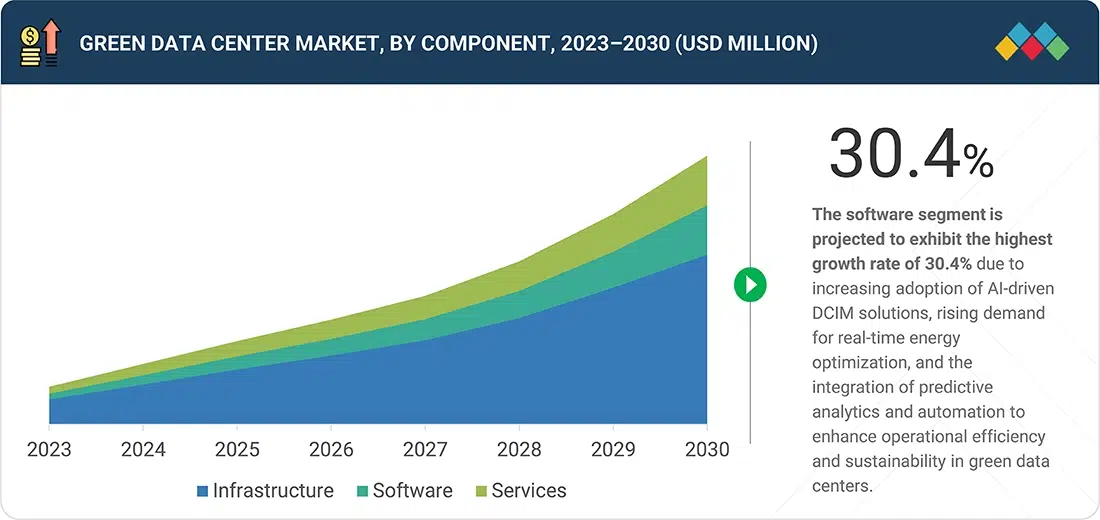
Software to Dominate Green IT Growth
IBM’s pivot to a software provider aligns with market trends, as software is the fastest-growing segment of the green data center market. This chart validates the strategy of focusing on high-margin AI solutions for energy optimization.
(Source: MarketsandMarkets)
IBM’s Strategic Investment Analysis: Funding Efficiency and Intelligence
IBM’s investment pattern reveals a dual focus on upgrading its own high-performance computing infrastructure while making strategic, software-oriented acquisitions to bolster its position as an energy intelligence provider. This approach avoids direct competition in large-scale renewable generation and instead channels capital toward less asset-heavy, higher-margin technology solutions that enable system-wide efficiency.
- A landmark commitment was the April 2025 announcement to invest $150 billion in the U.S. over five years, partly to fund new, energy-intensive facilities for quantum computer production. This large-scale investment necessitates a robust and cost-effective energy strategy, reinforcing the business case for its efficiency-focused software platforms.
- The company has made direct, albeit targeted, investments in on-site solar generation. The October 2025 completion of the 5.5 MW solar carport at its Watson Research Center in New York provides a direct, measurable return on investment and a tangible example of its sustainability efforts.
- The October 2024 acquisition of Prescinto, an AI-powered renewables asset management software provider, was a critical strategic move. This acquisition directly enhances the capabilities of IBM’s Maximo suite, adding advanced analytics for solar and wind assets to improve their operational efficiency and output, solidifying its role as a technology provider to the renewables industry.
Table: IBM’s Clean Tech and Data Center Investments
| Partner / Project | Time Frame | Details and Strategic Purpose | Source |
|---|---|---|---|
| Watson Research Center Solar Carport | October 2025 | Investment in a 5.5 MW on-site solar system generating 6.52 million k Wh annually. This project provides direct power, reduces operational costs, and serves as a customer showcase. | Power Flex |
| R&D in PNP Transistors | July 2025 | Investment in R&D to improve PNP transistor capabilities for renewable energy systems, enhancing the efficiency of core components like solar inverters. | Patsnap |
| 5-Year U.S. Investment Plan | April 2025 | A $150 billion strategic investment plan that includes funding for new, energy-intensive quantum computing facilities, driving the need for an efficient and sustainable energy strategy. | Reuters |
| Acquisition of Prescinto | October 2024 | Acquired an AI-powered renewable asset management software provider to integrate advanced analytics into the IBM Maximo suite, strengthening its commercial offerings for the energy sector. | ESG Today |
IBM Partnership Strategy 2026: Building an Ecosystem for Energy Management
IBM’s partnerships reflect its strategy to embed its technology across the energy and real estate sectors, creating an ecosystem where its software becomes the standard for managing sustainability data and optimizing asset performance. These collaborations move beyond simple energy procurement to establish IBM as an indispensable technology backbone for the green transition.
- The March 2025 proposal with Clean Energy Capital for a dedicated solar farm at its Hursley, UK data center is a key example of a partnership focused on direct, behind-the-meter power for a critical facility. This model ensures energy security and helps meet regional sustainability targets. The success of projects like this in the UK solar market could serve as a template for other locations.
- The collaboration with Power Flex for the Watson Research Center solar carport shows a multi-faceted approach. This partnership integrates clean energy generation with sustainable transportation by including 85 electric vehicle charging stations, showcasing a holistic campus sustainability model.
- Partnerships with firms like JLL and EY extend IBM’s reach into the broader corporate world. By integrating IBM Envizi and Maximo with the services of these global firms, IBM positions its software as the default tool for ESG reporting and asset management across vast commercial real estate portfolios.
- A collaboration with Matrix Renewables highlights IBM’s role in empowering the renewables sector. Matrix Renewables uses IBM Maximo to manage its own renewable energy assets, turning a client into a powerful case study for IBM’s technology.

Mapping the AI Data Center Ecosystem
This value chain illustrates the complex ecosystem IBM is navigating with its partnership strategy. It shows the key segments where IBM can embed its management software to become a technology backbone.
(Source: Generative Value)
Table: IBM’s Renewable Energy Partnerships
| Partner / Project | Time Frame | Details and Strategic Purpose | Source |
|---|---|---|---|
| Clean Energy Capital | March 2025 | Proposed a dedicated solar farm to directly power IBM’s Hursley data center in the UK, ensuring a secure, renewable energy supply for a critical European facility. | Data Center Dynamics |
| Power Flex | October 2025 | Developed a 5.5 MW solar carport at IBM’s Watson Research Center, with IBM subscribing to 40% of the output to directly power its operations. | Power Flex |
| Matrix Renewables | July 2025 | Matrix Renewables uses IBM Maximo software to streamline operations and manage its renewable energy assets, positioning IBM as a key technology provider to the renewables industry. | IBM |
| JLL | July 2024 | Launched a global sustainability solution combining JLL’s real estate expertise with IBM Envizi to enhance ESG data management and reporting for commercial properties. | ESG News |
| EY | March 2023 | Collaborated to integrate IBM Maximo into the EY Sustainability Enterprise Asset Management (SEAM) tool to help organizations calculate and manage carbon emissions from their assets. | IBM Newsroom |
IBM’s Global Footprint: European Expansion and U.S. On-Site Generation
IBM’s geographic strategy focuses on expanding its advanced, energy-efficient data center capacity in key European markets while deploying on-site solar generation at its core research and development hubs in the United States. This approach balances market expansion with the need for resilient, cost-effective power for its most critical innovation centers.
- Between 2021 and 2024, Europe was a major focus for infrastructure expansion. This included the launch of a cloud multi-zone region in Madrid, Spain, in 2023 and the opening of its first European quantum data center in Ehningen, Germany, in 2024. These projects were driven by regional demand for cloud and AI services.
- From 2025 onwards, the focus has included securing renewable power for these European assets. The proposed solar farm for the Hursley data center in the UK is a prime example of this shift, directly addressing the energy needs of a key European facility. This aligns with broader trends in European renewable policy.
- In the United States, the strategy is centered on its major campuses. The 5.5 MW solar project at the Thomas J. Watson Research Center in New York exemplifies a model of generating power at the point of consumption for its most important R&D facilities.
- Looking ahead, IBM has indicated that the availability of renewable energy is a critical factor for selecting new data center locations, particularly in high-growth regions like Southeast Asia. This approach de-risks future operations from volatile energy markets, as seen in places like Singapore.

IBM’s Global Data Center Network
This map provides a direct visualization of IBM’s global data center footprint, the subject of its geographic strategy. It highlights the extensive network across Europe and other key markets mentioned in the text.
(Source: PR Newswire)
Technology Maturity of IBM’s Data Center Strategy: Commercially Proven Software and Solar
IBM’s strategy is built on the deployment of commercially mature technologies, combining proven on-site solar installations with its market-ready suite of AI-driven software platforms. The company is not investing in speculative or early-stage hardware; instead, it is focused on scaling existing, reliable solutions to deliver immediate financial and environmental returns.
- In the 2021-2024 period, the technological focus was on deploying its highly efficient Power 10 servers. These servers enabled data center consolidation by offering significantly better performance per core, which reduced overall energy consumption. This was a hardware-centric approach to efficiency.
- The period from 2025 to today marks a significant pivot to deploying mature software and on-site generation. Products like IBM Maximo, Envizi, and Turbonomic are established platforms being actively marketed to manage energy consumption and carbon footprints. These are not pilot programs but full-scale commercial offerings.
- The use of solar technology in projects like the Watson Research Center carport is based on standard, bankable solar PV systems. This pragmatic approach minimizes technological risk and ensures predictable energy generation and financial returns, contrasting with the more experimental energy strategies of competitors like Google.
SWOT Analysis of IBM’s Data Center and Solar Strategy 2026
IBM’s software-first strategy creates a strong, defensible market position in energy management, but its relative caution on large-scale renewable generation exposes it to long-term risks from energy market volatility and grid constraints driven by the very AI boom it helps to power.

AI Boom to Drive Surging Energy Demand
This forecast quantifies a key threat in IBM’s SWOT analysis: the massive surge in energy demand from data centers. It shows the scale of the challenge that the entire industry faces in securing power.
(Source: Core Development Group)
Table: SWOT Analysis for IBM’s Data Center Strategy
| SWOT Category | 2021 – 2024 | 2025 – 2026 | What Changed / Resolved / Validated |
|---|---|---|---|
| Strengths | Strong brand reputation in enterprise IT. Deployed energy-efficient hardware like Power 10 servers. Established a 75% renewable energy goal. | Leveraging AI software (Maximo, Envizi) as a commercial product. Dual strategy of reducing internal costs while selling high-margin efficiency solutions to clients. Established partnerships with major firms like JLL and EY. | The strategy has been validated by the growing market for energy management software, allowing IBM to create a new revenue stream from its sustainability initiatives. The acquisition of Prescinto confirmed its commitment to this software-led model. |
| Weaknesses | Reliance on PPAs and other procurement methods for renewables. Less direct investment in renewable generation compared to competitors like AWS and Microsoft. | CEO Arvind Krishna’s public skepticism about the profitability of massive AI data center Cap Ex could signal a risk-averse culture that may limit necessary infrastructure investments. The strategy remains heavily reliant on grid stability. | The weakness persists. While on-site projects like the Watson solar carport are positive steps, the scale is minor compared to hyperscalers. The company remains exposed to energy price volatility and grid constraints. |
| Opportunities | Growing corporate demand for ESG reporting and sustainability solutions. Need for better asset management in the expanding renewable energy sector. | Positioning as the “brains” of the energy transition, providing the intelligence layer for all data centers. Capturing value from the entire tech sector’s energy transition, not just its own power consumption. Expanding into new solar growth markets. | The 2024 acquisition of Prescinto and the 2025 partnerships with JLL and Matrix Renewables validate the massive market opportunity for providing energy management software and services. |
| Threats | Rising energy prices and grid instability. Competition from hyperscalers building their own large-scale renewable projects. | Data center energy demand, projected to be 8% of global electricity use by 2030, could outpace the benefits of software-led efficiency gains. Competitors like Meta and Alibaba are exploring diverse energy sources, potentially gaining a cost or reliability advantage. | The threat is growing. CEO Krishna’s warning about an $8 trillion Cap Ex bubble highlights the financial risks, but failing to invest adequately in secure power could become a greater long-term threat to IBM’s AI ambitions. |
IBM’s Forward-Looking Outlook: Proving the Capital-Light Model in 2026
The critical factor for IBM in the year ahead is to demonstrate that its capital-light, software-centric energy strategy can deliver superior financial returns and operational resilience compared to the asset-heavy generation models of its competitors. Success will be measured by the market adoption of its energy management platforms and its ability to secure stable, low-cost power for its expanding AI and quantum infrastructure without engaging in a direct arms race for renewable generation.
- Execution of the proposed solar farm for the Hursley, UK data center will be a key indicator of IBM’s ability to replicate its on-site generation model in Europe. A successful project could create a blueprint for other global facilities.
- The allocation of the $150 billion U.S. investment will be closely watched. How much of this capital is directed toward sustainable infrastructure for its new quantum and AI facilities will reveal the true priority of energy resilience within its growth strategy.
- Market traction for the IBM Maximo, Envizi, and Turbonomic platforms is the ultimate test of the strategy. Strong sales and widespread adoption would validate the decision to focus on being a technology enabler rather than a power producer.
- Continued commentary from CEO Arvind Krishna on the financial viability of AI data center investments will provide important signals. His skepticism could either presage a broader market correction or leave IBM under-invested if the AI boom proves profitable and sustainable for its competitors.
Frequently Asked Questions
What is the fundamental shift in IBM’s energy strategy for its data centers?
IBM has pivoted from primarily being a passive buyer of renewable energy to becoming an active provider and enabler of energy efficiency. The new strategy focuses on commercializing its AI-driven software platforms like Maximo, Envizi, and Turbonomic to manage energy systems for itself and other companies, rather than competing in the capital-intensive race for large-scale energy generation.
Is IBM building its own large-scale solar farms like its competitors?
No, IBM is not competing with hyperscalers in building massive renewable energy projects. Its strategy is described as ‘capital-light,’ focusing on smaller, targeted on-site generation projects like the 5.5 MW solar carport at its Watson Research Center and a proposed solar farm for its Hursley, UK data center. The primary focus remains on software solutions.
What are the key software products at the center of IBM’s new strategy?
The core software products are the IBM Maximo Application Suite for AI-powered asset management (enhanced by the Prescinto acquisition), IBM Envizi for ESG data management and reporting, and Turbonomic for application resource optimization to improve efficiency and reduce energy use.
How is IBM using partnerships to advance its energy strategy?
IBM is building an ecosystem around its technology. It partners with energy developers like Clean Energy Capital for dedicated power to its data centers, collaborates with firms like JLL and EY to embed its Envizi and Maximo software in their real estate and sustainability offerings, and showcases how renewable energy companies like Matrix Renewables use its software, turning clients into powerful case studies.
What is the main weakness or threat to IBM’s software-focused energy strategy?
The primary threat, as identified in the SWOT analysis, is IBM’s reliance on grid stability and exposure to energy price volatility due to its limited investment in direct, large-scale renewable generation. There is a risk that the explosive energy demand from AI could outpace the benefits gained from software-led efficiency, potentially putting IBM at a cost or reliability disadvantage compared to competitors who are building their own vast power infrastructure.
Experience In-Depth, Real-Time Analysis
For just $200/year (not $200/hour). Stop wasting time with alternatives:
- Consultancies take weeks and cost thousands.
- ChatGPT and Perplexity lack depth.
- Googling wastes hours with scattered results.
Enki delivers fresh, evidence-based insights covering your market, your customers, and your competitors.
Trusted by Fortune 500 teams. Market-specific intelligence.
Explore Your Market →One-week free trial. Cancel anytime.
